
From Microfilm to Marvels: How Converting Old Media Can Uncover Hidden Gems
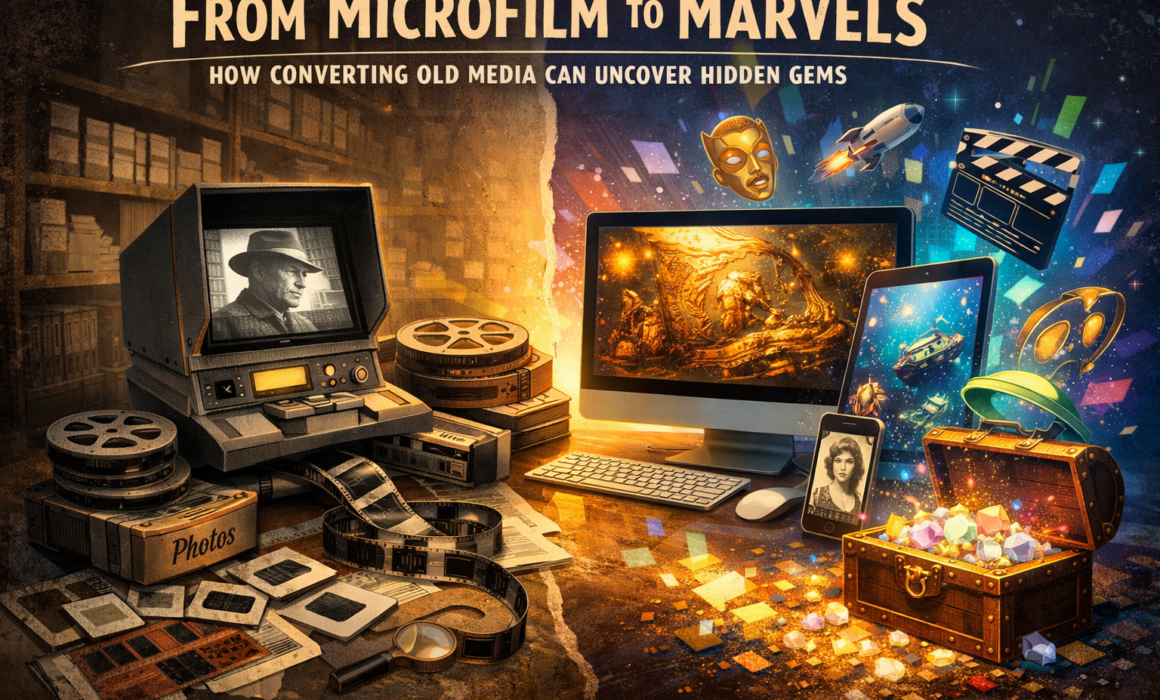
For decades, microfilm stood as the gold standard for preserving important information. Governments, financial institutions, libraries, and businesses relied on it to safely store vast amounts of records in a compact and cost-effective format. Today, organizations are taking the next step by transforming these archives through microfilm-to-digital conversion, unlocking entirely new value from materials that were once difficult to access.
Digitizing old media is not just about keeping up with technology. It is about rediscovering forgotten information, improving accessibility, and ensuring that valuable records continue to serve future generations in meaningful ways.
A Brief History of Microfilm—and Why It Still Matters
Microfilm has been used since the mid-1800s as a reliable method of preserving critical documents. Its widespread adoption came in the early 20th century, when innovations made it possible to efficiently store records such as financial documents on film. Over time, it became the primary archival solution across multiple industries.
By the mid-1900s, microfilm was widely used for government and municipal records, banking and insurance documents, immigration and adoption files, and historical newspapers. Even today, billions of pages remain preserved on microfilm and microfiche around the world, much of it untouched for decades.
Why Should I Convert Microfilm if It Already Lasts for Hundreds of Years?
Microfilm is known for its durability and can last for centuries when stored properly. However, longevity alone does not guarantee usability. Accessing microfilm requires specialized readers that are becoming increasingly rare and difficult to maintain. Searching for specific information is a manual and time-consuming process, and sharing records across teams or locations is often impractical.
Converting microfilm to digital format changes everything. It enables instant searchability, remote access, easy duplication, and seamless integration with modern document management systems. Rather than replacing microfilm, digitization enhances its value by making the information far more accessible and useful.
How Much Microfilm Is Still Out There?
Despite years of digitization efforts, a significant amount of microfilm still exists. Many organizations have only begun to scratch the surface of converting their archives, leaving vast collections waiting to be explored.
This is particularly true for municipal archives, legacy business records, historical collections, and financial or legal documentation. For many institutions, these archives represent untapped opportunities—valuable data that has yet to be fully utilized.
Can Damaged Microfilm or Microfiche Still Be Digitized?
In many cases, the answer is yes. Even microfilm or microfiche that appears damaged—whether scratched, faded, or brittle—can often be digitized using modern technology.
Professional digitization providers use advanced scanning equipment, image enhancement tools, and careful handling processes to recover as much information as possible. While not every frame can be perfectly restored, a large portion of degraded media can still be preserved digitally.
This makes digitization an essential step not only for convenience but also for preventing permanent data loss.
How Does Searching Work Once Microfilm Is Digital?
The real transformation happens after digitization. Once converted, microfilm records can be indexed and searched in ways that were never possible before.
Optical Character Recognition allows text within scanned images to be converted into searchable data, making it easy to locate specific keywords. Metadata tagging further organizes documents by categories such as date, name, record type, or department. Full-text search capabilities allow users to scan entire collections in seconds, a task that would have taken hours or even days with physical microfilm.
This level of accessibility dramatically improves efficiency, supports compliance, and enhances decision-making across organizations.
The Evolution from Microfilm to Digital
The shift toward digital archives began in the early 1990s as scanning technology improved and organizations sought more efficient ways to manage their records. Since then, advancements in digitization have made the process faster, more accurate, and more cost-effective.
Modern systems can handle microfilm, microfiche, and other archival formats at scale, allowing organizations to convert large collections with ease.
Why Digitizing Old Media Is a Strategic Advantage
Digitization is more than just an operational improvement. It provides a strategic advantage for organizations looking to stay competitive and efficient.
By converting old media into digital formats, organizations can improve regulatory compliance, enhance collaboration across teams, reduce physical storage costs, and respond more quickly to audits or information requests. It also strengthens data security by enabling backups and controlled access.
Most importantly, digitization allows organizations to fully leverage their historical data, turning static archives into active, valuable resources.
From Preservation to Possibility
Microfilm has served its purpose exceptionally well, preserving critical information for generations. Today, the challenge is no longer just preservation, but accessibility and usability.
Through microfiche scanning, archival digitization, and modern data management, organizations can bring new life to their records. Hidden insights can be uncovered, valuable information can be shared instantly, and archives can evolve from passive storage into powerful tools for discovery.
The result is a shift in perspective—from simply storing information to actively using it.
From microfilm to something far more impactful. From storage to discovery. From history to opportunity.