

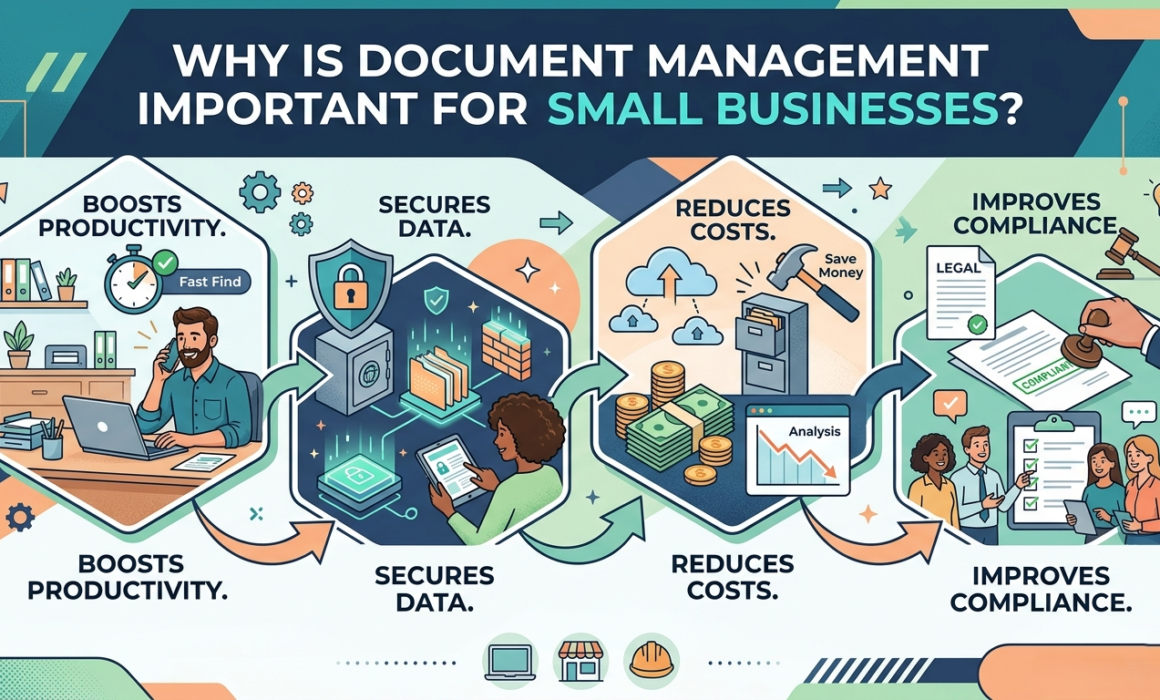
Why Is Document Management Important for Small Businesses?
Running a small business means wearing a lot of hats. The demands on a small team are constant, with many roles such as sales, operations, finance, and customer service. Administrative overhead can easily consume hours that would be better spent on growth. One of the most persistent sources of that overhead, and one of the most underestimated risks to business continuity, is poor document management.
Documents are the backbone of every business, holding contracts, invoices, employee records, and compliance filings. How they are stored, organized, accessed, and protected has a direct influence on productivity, security, and the ability to scale. For small businesses in particular, where margins are tighter and teams are leaner, getting this right is not an operational necessity.
The Hidden Cost of Disorganized Documents
Most small business owners think of document chaos as a minor irritant. A file saved in the wrong folder, an email attachment buried in an inbox, a signed contract that takes twenty minutes to locate. But these small inconveniences add up.
Studies consistently show that employees spend a significant portion of their working week searching for information rather than acting on it. In a small business, where every hour has outsized value, this is a drastic drag on performance. It also creates downstream problems: delayed invoice processing, missed contract renewal dates, difficulty responding to audits or legal requests, and the constant low-level stress of not being entirely sure where things are.
There is also the question of what happens when key people leave. In many small businesses, institutional knowledge about where things are stored and how to find them lives in people’s heads or personal file structures. When those people move on, that knowledge goes with them. A disciplined approach to document management creates processes and structures that belong to the business, not to any individual.
What Good Document Management Actually Looks Like
Best document management practices don’t require enterprise-scale infrastructure. For a small business, the fundamentals are accessible and, increasingly, affordable.
In summary, effective document management means having a clear, consistent system for how files are named, stored, versioned, and disposed of. It means knowing who has access to what, and being able to grant or revoke that access quickly. It results in documents being findable in seconds rather than minutes, and being confident that the version you’re looking at is the most current one.
It also means thinking about the full document lifecycle: from creation or receipt, through active use, to long-term retention or secure disposal. Different document types have different retention requirements, like tax records, employment contracts, and regulated correspondence. Each has its own legal retention schedule, and a well-designed system allows businesses to easily track and enforce these automatically.
For small businesses operating remote or hybrid teams, good document management also means the right people can access what they need from wherever they are, without compromising security or creating version control nightmares.
Why a Document Management System Changes the Equation
A document management system (DMS) brings structure, automation, and control to what is, in many small businesses, an ad hoc collection of shared drives, email threads, and desktop folders.
Rather than relying on individual naming conventions and folder structures that may or may not be followed by all, a DMS enforces standardization across the organization. Documents are tagged with metadata, version histories are maintained automatically, and search functionality means that finding any document takes seconds, regardless of who created it or when.
Workflow features in modern document management systems allow routine processes, like invoice approvals, contract sign-offs, and onboarding documentation, to be automated and tracked. Instead of a document sitting in someone’s inbox waiting for action, the system prompts the right person at the right time and records when each step was completed.
For small businesses with compliance obligations, this auditability is particularly valuable. Whether you’re responding to a tax review, a regulatory inquiry, or a client audit, being able to demonstrate a clear, timestamped record of your document handling is the difference between a straightforward response and a costly scramble.
Cloud-based document management systems have made this level of capability accessible to businesses of almost any size. The upfront investment is modest, implementation is fast, and the ongoing cost is typically far outweighed by the time saved and risks avoided.
Building a Foundation for Growth
One of the quieter arguments for investing in document management for small businesses is the scalability. A business that has clear, consistent document processes in place can onboard new staff more quickly, confidently bring in new clients, pursue regulated contracts that require demonstrable compliance, and integrate acquisitions or partnerships with far less friction.
Businesses that scale without addressing their document management infrastructure often get to a point where the informal systems that worked for a team of five become a liability for a team of twenty-five. Updating good practices is always harder than building them in from the start.
The right time to invest in a document management system is before a problem comes up.
FAQ
Why is document management important for small businesses?
Document management is particularly important for small businesses because the consequences of getting things wrong are immediate. Large enterprises can absorb the cost of a misfiled contract or a delayed invoice approval. A small business may not have that buffer available to it.
Beyond the immediate operational impact, poor document management creates compounding risks over time. Regulatory non-compliance can result in fines or legal exposure. Lost or inaccessible records make it difficult to resolve disputes with clients, suppliers, or employees. Inconsistent version control means decisions get made on outdated information. And when key staff leave, undocumented processes and informally stored files can leave a business scrambling to reconstruct basic operational knowledge.
On the positive side, businesses with strong document management practices consistently report higher productivity, faster decision-making, and greater confidence in their compliance positioning. For small businesses competing against larger, better-resourced rivals, this operational discipline can be a huge differentiator.
Good document management is also foundational to growth. Investors, acquirers, and enterprise clients increasingly scrutinize how businesses handle their records and data. A small business that can demonstrate clean, auditable, well-organized document practices is a more credible partner and a more attractive investment, and one that is far easier to scale.
What are the benefits of using a document management system (DMS)
Small businesses benefit in virtually every area operationally when a document management system is implemented.
The most immediate advantage is time. A well-enforced DMS eliminates hours spent searching for documents, reconciling different versions, and chasing approvals through email chains. Employees find what they need quickly, work from the correct version, and can see at a glance where a document is in its lifecycle.
Collaboration improves significantly. When documents are stored in a centralized, accessible system rather than in individual drives and inboxes, teams can work together more effectively, whether they are in the same office or spread across multiple locations. Real-time access to shared documents removes the need to email attachments back and forth, and version control ensures that no one is ever working on an outdated copy.
A DMS also brings consistency and standardization to document processes. Naming conventions, folder structures, metadata tagging, and retention schedules are enforced by the system rather than relying on individual discipline. This makes the organization’s document handling predictable and auditable, which matters when facing regulatory reviews, client due diligence, or internal quality assessments.
Workflow automation is another significant advantage. Routine document-driven processes, such as approvals, reviews, sign-offs, and renewals, can be automated within a DMS, reducing manual follow-up and ensuring nothing falls through the cracks. Notifications, reminders, and escalation rules keep processes moving without requiring constant human intervention.
Finally, a good DMS supports business continuity. Documents stored on local drives or personal laptops are vulnerable to hardware failure, theft, or disaster. Cloud-based document management systems provide automatic backup, redundant storage, and recovery capabilities that protect the business’s critical records against a wide range of risks.
How does a document management system improve data security?
Data security is one of the strongest arguments for implementing a document management system, and it is particularly relevant for small businesses, which are frequent targets of data breaches and cyber incidents, because their defences are often less mature than those of larger organizations.
A DMS improves data security in several interconnected ways.
Access control is the foundation. Rather than sharing files through open network drives or email attachments, where controlling who has access is difficult and monitoring is nearly impossible, a DMS allows administrators to precisely define who can view, edit, share, or delete each document or category of documents. Access can be granted and revoked instantly, which is particularly important when staff change roles or leave the organization.
Audit trails provide visibility into document activity that informal systems simply cannot offer. A DMS records who accessed a document, when, what changes were made, and whether it was shared externally. This level of traceability is valuable both for internal governance and for demonstrating compliance to regulators or clients.
Encryption protects documents both in transit and at rest. Reputable document management systems apply strong encryption standards that make intercepted or improperly accessed files unreadable without the appropriate credentials.
Retention and disposal controls reduce risk by ensuring that documents are not kept longer than necessary. Unnecessary data retention is a liability since documents that don’t exist cannot be breached. A DMS automates retention schedules and triggers secure disposal processes when documents reach the end of their required schedules.
Finally, cloud-based document management systems are maintained and updated by dedicated providers whose core business is the security and reliability of their platform. For a small business without a dedicated IT function, this means access to enterprise-grade security infrastructure without the cost or complexity of managing it in-house.
Getting Started with Document Management
For small businesses taking their first steps toward better document management, the most important thing is to start. A modest improvement in how documents are stored and accessed today creates the foundation for more sophisticated practices as your business grows.
Consentia works with small and mid-sized businesses across Canada to design and implement document management solutions that fit their scale, their industry, and their budget. Whether you’re looking to implement a new system from scratch or bring order to an existing document landscape, our team can help you build practices that protect your business and support your ambitions.