

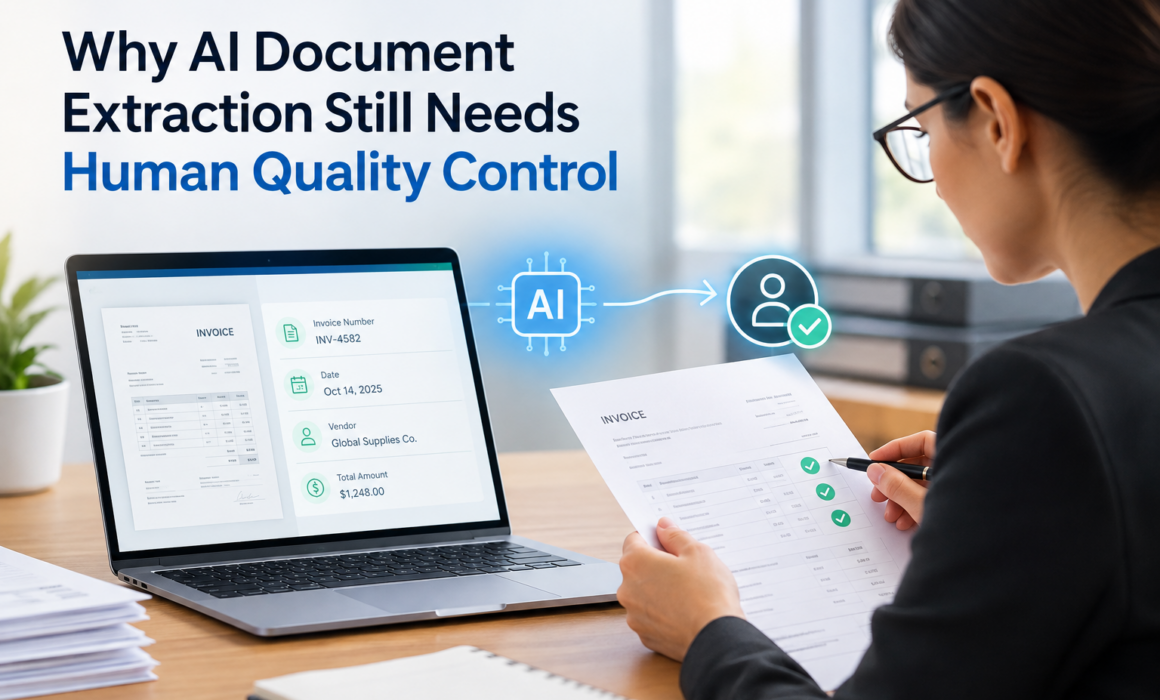
Why AI Document Extraction Still Needs Human Quality Control
AI document extraction has changed organizations’ capacity to handle paperwork. Law firms pull data from contracts in seconds. Real estate offices process closing documents without weeks of manual entry. Property managers can immediately retrieve tenant information from lease files. It seems like magic, and in many aspects it is, but magic still requires oversight.
No matter how advanced it becomes, AI document extraction is not infallible. It makes mistakes. It misreads. It misunderstands context that a human would catch instantly. This is why human quality control remains an essential stage of any serious document management strategy, even as AI-powered document extraction continues to improve.
What AI Document Extraction Actually Does
AI document extraction is the use of artificial intelligence, often paired with optical character recognition (OCR), to extract structured data automatically from documents. Instead of typing information manually from a PDF into a database, an AI document data extraction tool will scan the file, identify the relevant fields, and populate it accordingly.
This combination of OCR and AI document processing has made document extraction genuinely useful for high-volume industries. Automated document extraction allows your staff to focus on higher-value work, rather than doing monotonous tasks, such as data entry. For organizations processing high volumes of documents, intelligent document extraction is the difference between a team that is buried in paperwork and one that isn’t.
Where AI for Document Extraction Starts to Struggle
Here is the part that often gets left out of the sales pitch. AI document extraction accuracy depends heavily on what it is working with. A clean, digitally native PDF with a consistent layout is relatively easy for an AI system to read correctly. Real-world documents rarely look like that.
Documents that are faxed or photocopied multiple times, or scanned at a low resolution, can confuse well-trained models. Things that reduce the quality of the scanned document, such as faded ink, skewed pages, and smudged text, also reduce the reliability of the output given. AI document extraction for scanned documents is one of the more error-prone applications of this technology, particularly with older archives that predate digital record keeping.
Handwriting presents its own challenge. AI document extraction can process handwritten data, from a signature to a small note in the margin, but comes with reliability challenges, especially compared to typed documents. Handwriting varies by person, and even the best AI models can misread a number or a name depending on the writing legibility.
When AI extraction scans complex files, such as multi-page contracts with numerous clauses or tables that span several pages, problems tend to compound. These complex documents require AI to interpret context and hierarchy, which is where extraction errors tend to show up most, because the model has to infer the desired structure.
Unstructured documents add another layer of difficulty. AI document processing for unstructured documents, such as emails, memos, or free-form correspondence, asks the AI to identify relevant information without the benefit of consistent formatting. The same applies to PDFs that were designed without AI extraction in mind.
Different document types naturally bring their own challenges. Forms are tricky because AI has to match pieces of data to the correct field it belongs to. This becomes especially difficult when checkboxes, handwriting, or unusual layouts are involved. Invoices, for example, require precision. Line items, totals, and vendor details all need to be read correctly, but can be easily mixed up. Even one misread digit can throw off an entire accounts payable process. Contracts are their own challenge too since they require an understanding of legal language and clause structure, and general-purpose. This can cause AI models to stumble, especially when a contract references defined terms that appear elsewhere in the document.
Why Human Review in AI Document Extraction Still Matters
This isn’t to say AI document extraction isn’t valuable. It works best for most businesses when it’s part of a system. Human review in AI extraction closes the gap between what the technology can do reliably and what still requires judgment, context, or simple common sense that these tools lack.
Human quality control for AI document processing typically works through a human-in-the-loop model. The AI does the bulk of the work by reading documents and extracting data that would otherwise take humans a long time to do, then a trained reviewer checks the output, flags anything that looks off, and corrects any errors made before the data moves downstream into a client file, a database, or a compliance record.
AI document extraction with human validation is particularly important in regulated industries since an extraction error isn’t just an inconvenience, but can become a compliance issue.
This is where AI document processing accuracy becomes a shared responsibility between the technology and the people using it. The AI provides speed and scale, and humans provide judgment, context, and accountability, which together create results that neither could achieve alone.
Building a Document Extraction Process That Works
For organizations deciding whether to bring AI document extraction into their operations, it is important to remember it isn’t choosing automation over manual review. The goal is to design a workflow where each does what it is best at to improve efficiency, while maintaining quality of work.
That usually means starting with a clear sense of document volume and complexity. Straightforward, well-formatted documents can move through automated document extraction with lighter human oversight. Complex contracts, handwritten forms, or degraded scans warrant closer review before the extracted data is trusted. A thoughtful process routes documents accordingly rather than applying the same level of scrutiny to everything.
It’s also important to train reviewers on how to spot errors and ones that AI extraction tools tend to make. Spotting an AI extraction error isn’t always obvious and requires an understanding of both the document type and the common failure points of the extraction tool being used. It could be misread numbers on an invoice, missed clauses in a contract, or fields populated with the wrong information entirely.
Finally, it means treating quality control as an ongoing part of the process rather than a one-time check. As document types change, new templates are introduced, and AI models are updated, the review process needs to be ongoing. What worked well for one batch of documents could need adjustment for the next.
Frequently Asked Questions
Why does AI document extraction need human review?
AI document extraction can misread text, misidentify fields, or misunderstand context, particularly with low-quality scanned documents, handwriting, or complex layouts. Human review catches these errors before the data is used for decisions or compliance purposes, which is especially important for organizations that handle sensitive information.
Can AI extract data from documents accurately?
Yes, in many cases. AI document extraction performs well on clean, consistently formatted documents such as digitally native PDFs. Accuracy drops with scans of poor-quality, handwritten entries, and documents with complex or inconsistent structure, which is why accuracy should be evaluated based on document type.
How accurate is AI document extraction?
Accuracy varies widely depending on document quality, format, and complexity. Well-structured typed documents can see very high accuracy rates. Degraded scans, handwritten forms, and multi-page contracts tend to see more errors. This variability is the reason human quality control remains part of a reliable document processing workflow.
Why is human-in-the-loop important for AI document processing?
A human-in-the-loop approach combines the speed of AI with the judgment of humans. The AI handles high-volume extraction quickly, while the human catches errors, resolves ambiguity, and applies context the AI may not recognize on its own. This combination produces more reliable results in less time.
What are the limitations of AI document extraction?
Common limitations include difficulty with poor-quality or low-resolution scans, unreliable results with handwritten text, challenges interpreting complex or unstructured documents, and errors in documents that mix narrative text with structured data, such as contracts or forms with non-standard layouts.
How do humans verify AI-extracted data?
Trained reviewers compare the AI’s output against the original document, checking for misread fields, incorrect values, and missing information. In many workflows, documents are routed for review based on complexity or risk, so higher-stakes documents like contracts and invoices receive closer scrutiny than simpler, well-formatted files.
Can AI completely replace manual document processing?
Not reliably, at least not yet. AI document extraction significantly reduces the manual workload, but full replacement of human oversight introduces risk, particularly for regulated industries and documents where errors carry legal or financial consequences. Most effective systems combine automation with human quality control rather than removing people from the process entirely.
How does human quality control improve AI document processing?
Human quality control adds a layer of accountability and context that AI alone cannot provide. Reviewers catch errors before they reach downstream systems, ensure extracted data meets the privacy and record-keeping standards a business is held to, and provide feedback that can help refine the extraction process over time.