
Future-Proofing Your Mailroom: Adapting to Changing Business Needs
The modern business world doesn’t sit still for long. Customer expectations change quickly, regulations get updated, hybrid work keeps reshaping how teams operate, and the mailroom ends up right in the middle of all of it.
For many organizations, the mailroom is still the first stop for important documents like contracts, invoices, and parcels. Even so, it’s often overlooked when it comes to planning and investment.
Future-proofing your mailroom is really about building operations that can handle change without falling apart and ideally, turn that change into an advantage instead of a disruption.
Why the Mailroom Deserves a Seat at the Strategy Table
Mailrooms have traditionally been treated as background operations, something that just needs to keep running.
But as more organizations go through digital transformation, the mailroom has become the link between physical documents and digital workflows.
Think about what flows through a typical mailroom today: legal documents, financial records, onboarding packages, medical files, supplier invoices, and customer returns. How those items are received, sorted, and routed directly affects compliance, productivity, and customer experience.
Organizations that are rethinking the mailroom aren’t just improving operations. They’re building a stronger foundation for how information moves through the business.
The Shift Toward Mailroom Automation
One of the biggest changes in mailroom operations right now is automation.
What used to require teams manually sorting and scanning mail can now be handled through a mix of intelligent document recognition, workflow automation, and integrated digital systems.
Automation brings a few clear benefits:
Speed and accuracy. Automated systems reduce bottlenecks from manual handling. Documents get to the right place faster, with fewer errors and less risk of things being lost or misfiled.
Scalability. Whether you’re handling 500 items or 50,000 a week, automated systems can adjust without needing to scale headcount at the same rate.
Auditability. Every item is tracked from the moment it enters the system. That visibility is especially important in regulated industries like finance, healthcare, and legal.
Integration. Modern systems don’t work in isolation. They connect with tools like ECM platforms, ERPs, and CRMs so information flows directly into the systems people actually use.
The Strategic Role of Business Process Outsourcing
For many organizations, the most practical way to modernize the mailroom is through a specialist partner.
Business process outsourcing (BPO) isn’t just about cutting costs anymore. In many cases, it’s about gaining access to better tools, deeper expertise, and more flexibility than you could realistically build in-house.
A strong BPO partner can offer:
Access to better technology. Providers continuously invest in automation, AI tools, and compliance systems so you benefit from those upgrades without having to fund them directly.
Flexible capacity. Mail volumes aren’t consistent. They change with seasons, growth, or unexpected events. A BPO partner can scale operations up or down as needed.
Shared responsibility for risk. Things like compliance, data security, and continuity planning are handled jointly, often with strong certifications and safeguards already in place.
At Consentia, our mailroom solutions are built around this kind of partnership approach. We combine operational expertise with technology-driven workflows that can scale with your business.
Building a Resilient Mailroom
Whether you manage your mailroom internally or work with a BPO partner, there are a few key areas that make the biggest difference over time:
1. Digitization at the Point of Entry
The sooner physical mail becomes digital, the easier it is to manage. High-volume scanning combined with OCR helps reduce delays and makes documents searchable almost immediately.
2. Workflow Intelligence
Digitizing documents is only the first step. The real value comes from classifying and routing them correctly. With the help of automation and rules-based systems, urgent items can be prioritized while routine ones move through without manual effort.
3. Integration with Enterprise Systems
A disconnected mailroom slows everything down. Integration with finance, HR, legal, and customer systems ensures information lands where it’s needed without extra steps.
4. Compliance and Security by Design
With privacy regulations always evolving, security is crucial. Strong access controls, retention rules, and chain-of-custody tracking are essential.
5. Continuous Improvement
A modern mailroom isn’t “set and forget.” It should be measured, reviewed, and improved over time using clear KPIs and regular check-ins.
FAQ: Your Questions Answered
What trends and developments are shaping the future of mailroom management?
Several changes are happening at the same time.
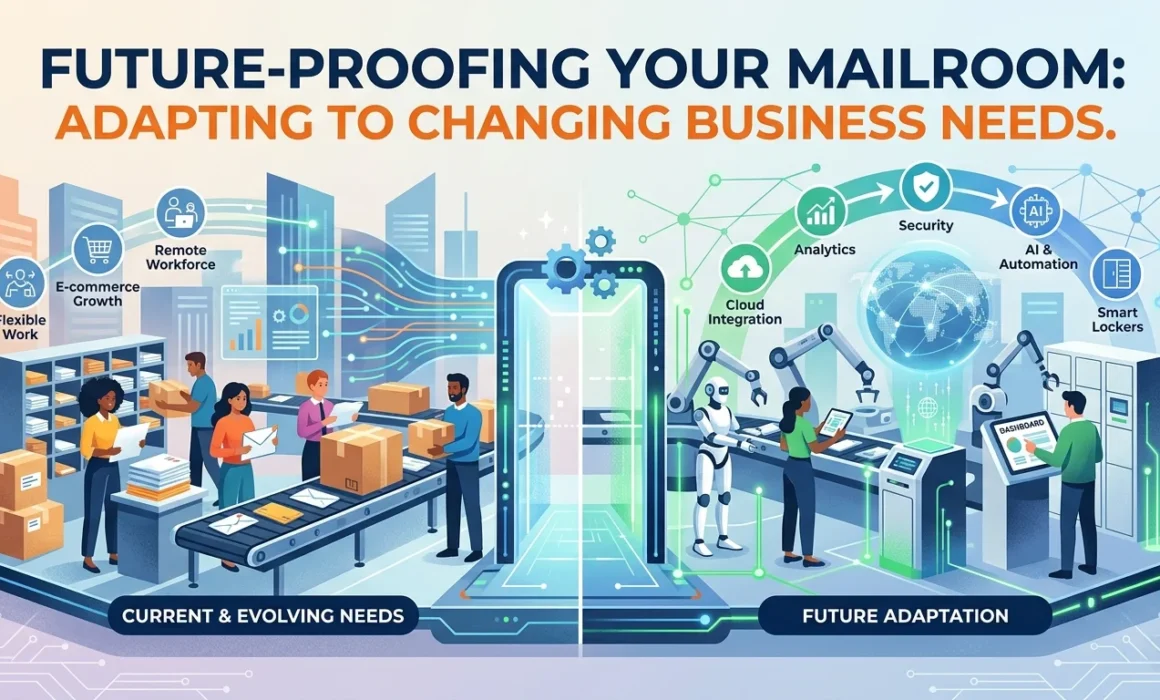
Hybrid and remote work have made traditional mail delivery less practical, pushing organizations toward digital mailrooms that can route documents to people wherever they are.
AI and machine learning are also playing a bigger role. These tools can now classify documents, extract key data, and route items with much higher speed and consistency than manual processes.
Cloud platforms are replacing older on-premise systems, making it easier to scale and connect systems across multiple locations.
At the same time, regulations around data handling and privacy are getting stricter, especially in sectors like finance, healthcare, and government.
There’s also growing pressure around sustainability, which is accelerating the move away from paper-heavy processes.
Altogether, these trends are pushing the mailroom from a manual back-office function into something far more automated and data-driven.
How can businesses future-proof their mailroom operations to adapt to evolving business needs?
The first step is understanding where you are today.
Start by looking at volumes, document types, processing times, and where delays or errors tend to happen. That baseline makes everything else clearer.
From there, automation should be introduced where it makes sense, usually in high-volume, repetitive areas like invoice processing, onboarding documents, or inbound correspondence.
It also helps to think in terms of platforms rather than isolated tools. Systems that integrate well are much easier to scale and adapt later.
For many organizations, working with a BPO partner is also part of the strategy, especially if internal resources are limited.
Finally, future-proofing is ongoing. It requires regular reviews, adjustments, and a willingness to refine processes as needs change.
What steps should companies take to stay agile and responsive in the face of technological advancements and industry changes?
Agility in a mailroom isn’t just about having the latest technology. It requires being able to adapt without disruption.
Modular systems help a lot here. When platforms are built in components, you can update or replace parts without rebuilding everything.
It also matters who you work with. Whether it’s a vendor or a BPO partner, their roadmap should show that they’re actively improving their platform, not just maintaining it.
People matter too. Training and change management are often overlooked, but they’re what make the technology actually work in practice.
It also helps to plan for different scenarios in advance so you’re not reacting under pressure when things change.
And finally, good partners should bring insight, not just execution. A strong BPO provider will help you understand trends and benchmark performance, not just process documents.
Ready to Future-proof Your Mailroom?
At Consentia, we help organizations across Canada modernize their mailroom operations so they can handle today’s demands and whatever comes next.
Whether you’re exploring automation for the first time or refining an existing BPO setup, we work with you to build a solution that fits how your organization actually operates—and can grow with it over time.