

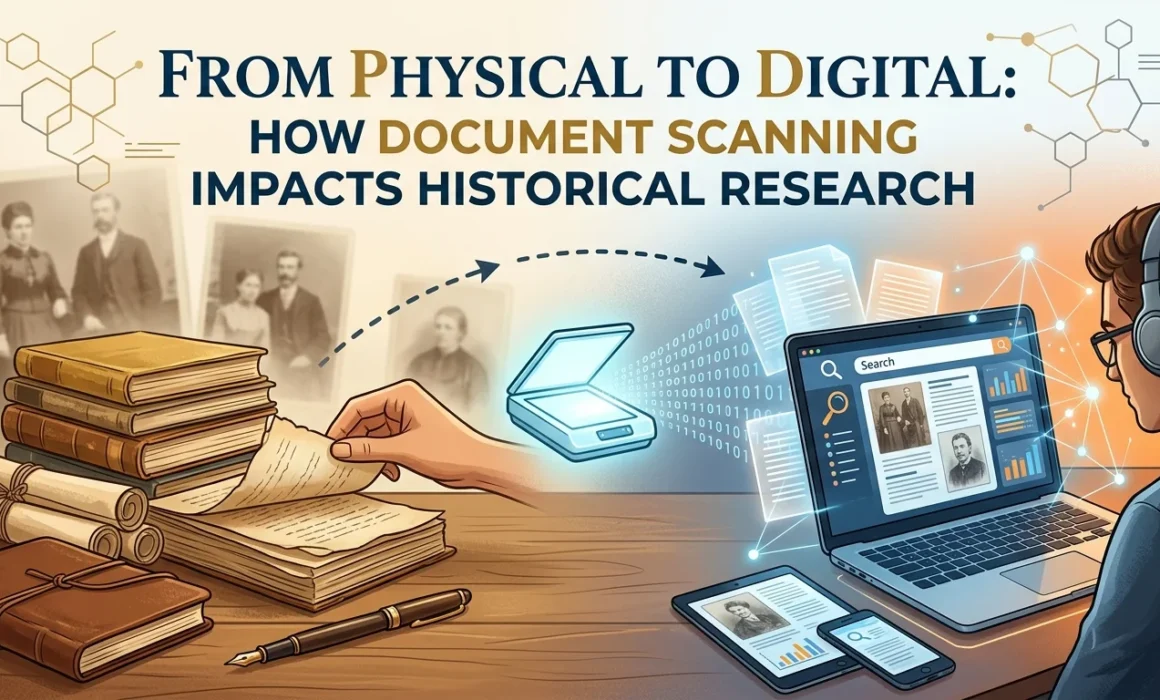
From Physical to Digital: How Document Scanning Impacts Historical Research
The texture of aged paper and the faded ink of a handwritten signature on a century-old document is irreplaceable. Although these records are keepsakes, physical records inevitably deteriorate from use, even when stored securely. Paper documents also risk unpredictable loss due to fires, floods, and humidity. Even when documents do survive, they are often locked away in archives that are accessible to very few people or institutions.
The digitization of historical documents is changing this in many ways. For researchers, genealogists, educators, legal professionals, and institutions, the shift from physical to digital isn’t only a matter of convenience, but also fundamentally reshaping what historical inquiry looks like and who gets to participate in it.
Why Scanning Is the Foundation of Modern Historical Research
Ask any archivist or historian what their greatest obstacle is, and the answer is usually protecting the documents they already have while making them usable.
Historical document scanning addresses this problem. When a physical record is digitized, two things happen: a high-fidelity digital copy is created that can be accessed, searched, and shared without ever having to touch the original, which results in the original being handled far less frequently and being stored in optimal conditions to preserve it beyond what would otherwise be possible.
This plays a pivotal role in research. The value of a historical document lies in its content and its context, and it contains information that cannot be recovered once lost. Scanning converts the irreplaceable into the reproducible.
Beyond preservation, digitization unlocks the research value of collections that would otherwise remain effectively invisible. A box of uncatalogued letters sitting in a regional archive is, for most purposes, inaccessible because no one knows it exists or can realistically visit to examine it. Once scanned and indexed, that same collection becomes discoverable by researchers anywhere.
The importance of historical document scanning to the research community, then, cannot be overstated. It is not a digitization project. It is an access project, a preservation project, and a legacy project all at once.
Breaking Down the Walls of the Archive
For most of the history of historical research, access has been rationed by geography, institutional affiliation, and resources. A PhD student at a well-funded university could afford to fly to a national archive and spend a week in the reading room. An independent researcher in a small town, or a student without travel funding, could not.
The digitization of archives dismantles this hierarchy. When collections are scanned and made available through online portals, digital libraries, or institutional repositories, the playing field shifts dramatically. A researcher in rural Alberta can access the same digitized land registry records as a professor at an Ivy League institution.
This decentralization of access has accelerated the pace and diversity of historical inquiry in ways that would have seemed impossible a few years ago. Citizen historians, community researchers, and students at underfunded institutions are contributing meaningfully to the historical record in ways that were simply not possible when access required physical presence.
There are also practical benefits for institutions themselves. Digital access reduces the number of researchers who need to handle physical originals, which extends the life of those documents. It reduces administrative burden on archival staff, who spend less time facilitating supervised access to fragile materials. And it creates new opportunities for institutions to share, cross-reference, and collaborate on collections across geographic boundaries.
Perhaps most significantly, digital preservation creates redundancy. A collection that exists only in one physical location is one disaster away from permanent loss. A digitized collection can be mirrored across multiple secure servers in different locations, ensuring that no single event can erase it.
What Happens to Documents That Time Has Already Damaged?
Torn pages, water damage, faded ink, mould, foxing, and brittleness are common in historical archives. The good news is that modern digital preservation of historical records has developed advanced solutions to these challenges. Specialized scanning technologies, including multispectral imaging, infrared photography, and ultraviolet illumination, can reveal text that is invisible to the naked eye. Faded handwriting that appears as a trace on the original document can be rendered legible in the digital copy through the manipulation of light wavelengths that the original ink absorbs or reflects differently than the surrounding paper.
Damaged or fragile documents are handled with specialized equipment designed to minimize stress during capture. Planetary scanners, for instance, allow pages to lie flat without being pressed under glass, which is critical for documents that cannot safely be flattened or opened fully. Overhead scanners and photographic rigs can capture items that are too fragile, too thick, or too three-dimensional for conventional flatbed equipment.
After capture, post-processing techniques can further enhance legibility. Contrast adjustment, noise reduction, and image stitching for torn or incomplete documents can produce digital versions that are, in some respects, more readable than the originals. Optical character recognition (OCR) can then convert scanned images into searchable text, making even handwritten or typewritten documents from centuries past indexable and searchable.
However, some documents are simply too deteriorated to yield a complete record. But the capabilities of modern scanning and image processing technology mean that the threshold for “too damaged to digitize” is far lower than most people assume. In many cases, digitization reveals content in damaged documents that has not been read in decades, or ever.
The implication for institutions sitting on deteriorating collections is clear: waiting is not a neutral choice. Every year of delay is a year of further degradation. The earlier a damaged document is scanned, the more information can be recovered.
The Broader Legacy of Getting This Right
The digitization of historical documents is ultimately an act of responsibility for the researchers of today and for the generations who will come after. The decisions that institutions, governments, and businesses make now about which records to preserve and how will shape what future historians have to work with.
This is not a hypothetical concern. We know from history that gaps in the documentary record create gaps in our understanding of the past. Communities whose records were not preserved struggle to reconstruct their histories. The digitization of archives is, in part, an opportunity to correct some of those historical imbalances by prioritizing the preservation of collections that have been overlooked or underfunded.
At the same time, the practical business case for digital preservation is strong and immediate. Organizations with large physical document holdings face real risks from disaster, deterioration, the compounding cost of physical storage, and the growing expectation among clients, partners, and regulators that records be accessible, searchable, and secure.
The transition from physical to digital is not something that needs to happen all at once. A well-designed digitization programme identifies the highest-priority collections to begin with, then works methodically through them all over time.
Making Digitization Work in Practice
For organizations beginning or expanding a digitization programme, a few principles consistently distinguish successful projects from ones that stall or underdeliver.
Define the purpose clearly. Are you digitizing for preservation, for access, for compliance, or all three? The answer shapes decisions about resolution, format, metadata standards, and storage architecture.
Invest in metadata. A scanned document with no contextual information attached to it is nearly as inaccessible as a box in an unlabelled cabinet. Robust metadata, such as date, author, subject, collection, and physical location of the original copy, is what makes digitized archives genuinely searchable and useful.
Choose formats for longevity. File formats come and go. Digitization programmes should use open, widely adopted standards (such as TIFF for archival masters and PDF/A for access copies) that are unlikely to become unreadable as technology evolves.
Plan for storage and redundancy. Digital files require ongoing storage, backup, and migration as storage media ages. A digitization project without a long-term stewardship plan simply defers the risk rather than eliminating it.
Partner with specialists. High-quality historical document scanning requires equipment, expertise, and quality control processes that most organizations don’t maintain in-house. Working with an experienced document management partner ensures that capture quality meets archival standards and that the project is completed efficiently.
The shift from physical to digital is already well underway across archives, libraries, government repositories, and private collections. For organizations that have not yet begun, or that have started but lack a coherent strategy, the opportunity to act is now. The documents that define your history, and perhaps the history of your community or industry, are not getting any younger.