

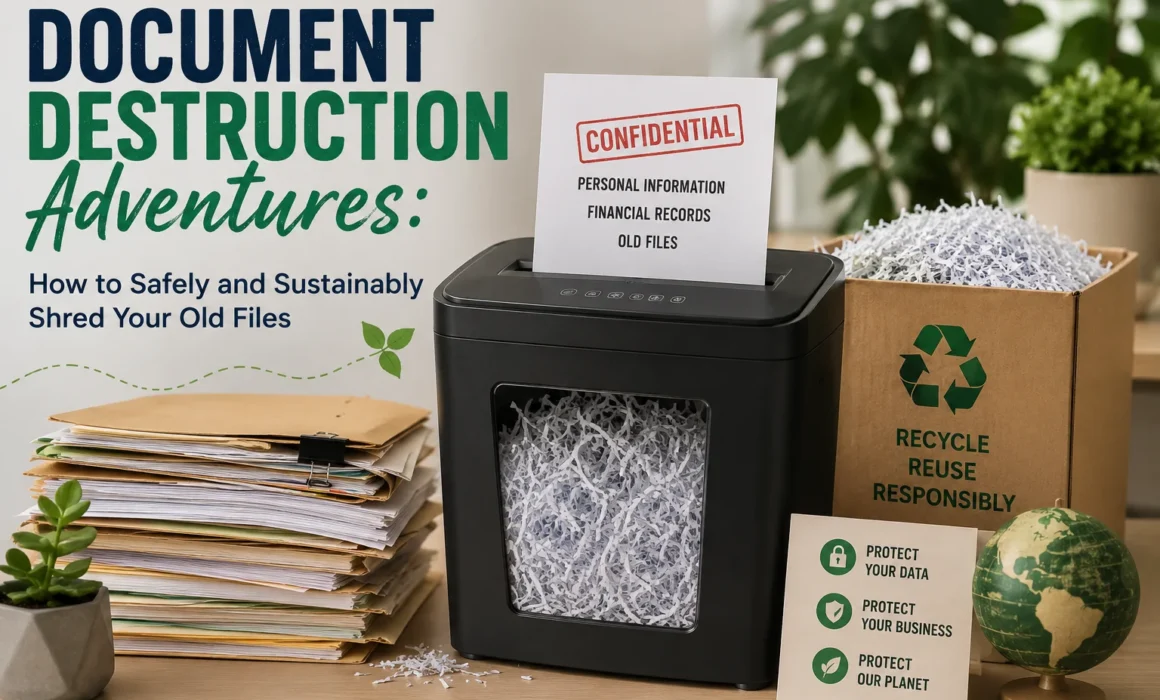
Document Destruction Adventures: How to Safely and Sustainably Shred Your Old Files
Filing cabinets hold a unique and quiet kind of anxiety. Sitting in folders are sensitive documents like medical records, old tax returns, and pay stubs. They sit there doing nothing until they end up in the wrong hands.
Secure document destruction isn’t reserved for corporations and law firms. Every day, people are affected by identity theft and data breaches because of the overlooked habit of shredding important documents.
In this blog, we explain when to shred, how to shred, what to do with the aftermath, and how to handle materials that go beyond paper.
Why Secure Document Destruction Actually Matters
Identity theft doesn’t usually start with a sophisticated cyberattack. It can happen with a discarded bank statement in a recycling bin, a medical bill left on a curb, or an old pre-approved credit offer that was tossed in the garbage.
According to the Federal Trade Commission, every year, identity theft remains one of the most commonly reported consumer complaints. And while people are becoming increasingly cautious about their digital footprints, physical documents remain a significant vulnerability that shouldn’t be forgotten. A shredder or access to a professional document shredding service is one of the most cost-effective tools in identity theft prevention.
The core rule is simple: if a document contains your name alongside any identifying number (account number, Social Insurance or Social Security number, date of birth, medical record number, or financial data), it should be destroyed before disposal.
How Long Should You Actually Keep Documents?
Before you start feeding paper into a machine, it’s important to know what’s actually safe to shred. Holding onto documents longer than necessary is its own kind of risk — the more you keep, the more exposure you carry. But shredding too early can create headaches with tax audits or legal matters.
Here’s a guideline to follow:
Keep for one month or less: ATM receipts, bank deposit slips (once reconciled with your statement), and store receipts for everyday purchases with no warranty or tax relevance.
Keep for one year: Monthly bank and credit card statements (once you’ve confirmed they match your annual summary), pay stubs (until you receive your T4 or W-2), and utility bills (unless needed for home office deductions).
Keep for seven years: Tax returns and all supporting documentation. Canada Revenue Agency and the IRS can audit up to six years back in most situations, so seven years is the safe buffer. This includes receipts, charitable donation records, business expense logs, and investment purchase records.
Keep indefinitely: Legal documents like wills, marriage and divorce certificates, adoption records, property deeds, and vehicle titles. These should be stored securely, not shredded.
Keep until updated: Insurance policies (shred old ones once replaced), passports and ID cards (shred expired ones), and warranties (shred after the product is gone).
Once a document has served its retention window, the clock on secure document destruction starts immediately.
Choosing Your Shredding Method
When it comes to shredding old files, you have two main paths: doing it yourself with a personal shredder or handing it off to a professional document shredding service.
Personal shredders: Overview of cut types
Not all shredders are equal, and the difference matters more than most people realize.
A strip-cut shredder slices paper into long vertical ribbons. It’s fast and cheap, but the strips can theoretically be reassembled, making it the least secure option and largely inadequate for anything containing sensitive personal or financial information.
A cross-cut shredder cuts paper into small, rectangular confetti-like pieces by slicing both vertically and horizontally. This is a significant step up and is appropriate for the vast majority of personal and home office use. A typical cross-cut shredder produces several hundred pieces from a single sheet, making reconstruction impractical.
A micro-cut shredder goes further still, producing tiny square or diamond-shaped particles sometimes thousands of pieces per page. Micro-cut machines meet the higher security standards often used in government and legal settings and are the right choice if you’re handling highly sensitive materials. They’re more expensive and often slower, but for the level of protection they offer, the premium is well justified.
For most households and small businesses, a cross-cut shredder is the sweet spot of security, cost, and speed. If you’re regularly handling documents at a higher sensitivity level, a micro-cut is worth the investment.
One practical note: You do not need to remove staples or standard paperclips before shredding. Most personal cross-cut and micro-cut shredders are designed to handle staples without issue. Binder clips and large metal fasteners are another matter; remove those, as they can jam or damage the cutting mechanism. When in doubt, check your shredder’s manual for its specific tolerances.
Professional Document Shredding Services
When volume or sensitivity exceeds what a personal shredder can reasonably handle, professional document shredding services are the right call. These companies use industrial-grade equipment that destroys documents to a certified standard and typically provide a Certificate of Destruction a formal record that the material was processed securely and compliantly.
This matters for businesses operating under privacy regulations (PIPEDA, HIPAA, GDPR, and similar frameworks), but it’s also increasingly relevant for individuals going through estate administration, medical record purges, or high-volume home office cleanouts.
Many services offer drop-off locations, scheduled on-site shredding (a truck comes to you), or mail-in programs for lower volumes.
At Consentia, our secure document destruction services are designed to handle exactly these situations — providing compliant, auditable destruction for both businesses and individuals, with full chain-of-custody documentation.
What Happens to the Paper After It’s Shredded?
This is where the eco-friendly paper disposal conversation gets interesting — and a bit more complicated than most people expect.
Can you put shredded paper in your curbside recycling bin?
Technically, shredded paper is recyclable. Practically, curbside programs often can’t process it effectively. The problem is size: most municipal recycling systems use optical sorting technology that works by detecting full sheets of paper. Tiny shreds slip through the sorting screens, contaminate other materials, and end up in landfill anyway or worse, create jams in processing equipment.
The answer varies by municipality. Some accept shredded paper if it’s contained in a sealed paper bag or stapled closed; others explicitly reject it. Before assuming your shredded paper is being recycled, check directly with your local waste management provider. Most curbside recycling websites have a material-by-material lookup.
If your program doesn’t accept shredded paper, you have better options.
Composting shredded paper
Plain shredded paper from a home printer or standard office documents is an excellent addition to a compost pile or bin. It counts as a “brown” (carbon-rich) material, balancing the “green” (nitrogen-rich) materials like food scraps and grass clippings. Shredded paper breaks down readily, helps with aeration, and prevents the pile from becoming too wet or compacted.
A few guidelines: glossy paper, heavily inked paper, and paper with waxy coatings should be kept out of the compost. Plain white office paper, newsprint, and kraft paper (like paper bags) are all ideal. If you’ve been shredding confidential documents, composting the output is actually a doubly responsible choice — the material is returned to the earth, and there’s no risk of reconstruction.
Drop-off recycling programs
Many communities have dedicated drop-off sites for materials that curbside programs can’t handle, including shredded paper. Office supply retailers, community events, and municipal depots often accept it. Some document shredding services also recycle the output themselves — ask when you book.
Beyond Paper: What to Do With Old Credit Cards, Hard Drives, and Electronics
Secure document destruction doesn’t stop at paper. Some of the most sensitive information people hold exists on physical items.
Old credit and debit cards: Cut them up diagonally, through the chip and magnetic stripe — before disposal. Many people simply toss expired cards in the recycling bin. This is enough of a risk that it’s worth the extra ten seconds with scissors. Some financial institutions will take back cards for proper disposal.
Hard drives and other digital storage: This is where the stakes are highest, and the DIY instinct can mislead you. Deleting files or even “factory resetting” a hard drive does not fully remove the data. Recovery tools can retrieve it. If you’re disposing of an old computer, external drive, USB stick, or memory card, the drive needs to be physically destroyed or degaussed (exposed to a strong magnetic field that scrambles the data).
Professional data destruction services handle this some document shredding companies have expanded into electronic media destruction, and there are dedicated e-waste processors who specialize in certified hard drive shredding. Ask for documentation that confirms the destruction method and security standard used.
Old phones and tablets: Before disposal, perform a proper factory reset after removing the SIM card and any memory cards. For iPhones, sign out of your Apple ID first; for Android devices, encrypt the device before resetting to make residual data unreadable. Then bring the device to an electronics recycler — many carriers and manufacturers have take-back programs.
Other sensitive physical items: Prescription labels, medication bottles with your name on them, and anything with a barcode tied to your account (like a loyalty card or insurance card) should be destroyed before disposal. Prescription labels in particular contain your name, doctor’s name, medication, and dosage a useful package of information for anyone with harmful intent.
Building a Shredding Habit That Sticks
The most secure approach to document destruction is a consistent practice. A small shredder near your desk or mail station means that junk mail with your name, account statements you’ve already filed digitally, and expired cards get destroyed in the moment rather than accumulating in a pile that waits months for attention.
For higher volumes annual tax season cleanouts, office relocations, estate administration — scheduling a professional document shredding service removes the bottleneck entirely and ensures the job is done to a certified standard.
The goal isn’t paranoia. It’s proportion: sensitive information should receive a level of protection proportionate to the harm its exposure could cause. For most documents, that means a decent cross-cut shredder and a compost bin. For others, it means a certified destruction service and a formal record that it happened.
Either way, the filing cabinet anxiety starts to lift. And that’s worth something too.
Consentia provides secure document destruction and records management services for businesses and individuals. To learn more about our document shredding services, on-site destruction programs, and compliance solutions, contact our team.