

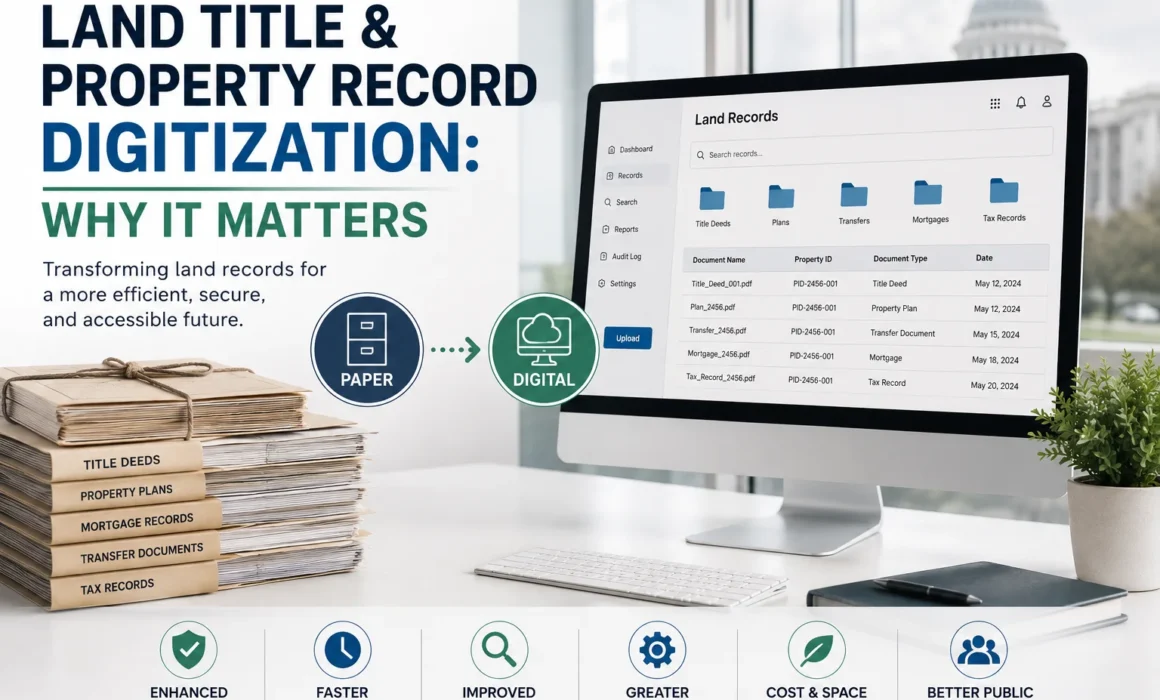
Land Title and Property Record Digitization: Why It Matters
Property records are among the most important documents maintained by multiple organizations. They are handled by governments, law firms, real estate organizations, financial institutions, and other organizations involved in land and property management. Ownership, transactions, boundaries, mortgages, assessments, and other details must be documented and remain relevant over long periods.
Even with the importance of these property records, they are usually still in paper files, aging folders, microform, or other physical formats, which doesn’t support the mandatory longevity of these documents. As these materials age, they can become difficult to access, be vulnerable to damage, and become increasingly difficult to store and manage.
Property record digitization preserves these valuable records while making them easier to access, search, and manage. From land title digitization and property document scanning to OCR and secure digital storage, organizations can transform physical archives into searchable digital property files that are easier to work with and protect.
Understanding the Value of Property Records
Information in property records can include ownership, history, legal status, and property characteristics. Things such as land titles, deeds, mortgages, property transfers, surveys, site plans, easements, liens, tax records, building records, and property assessments can also be included, depending on the jurisdiction.
Together, these documents can form a detailed real estate records archive, providing a historical record of how a property has changed over time. This information needs to be accurate, accessible, secure, and protected throughout the required lifecycle of these records, so having effective land records management is crucial.
The challenge is that when the amount of physical records inevitably grows, things become increasingly difficult to find. Searching for a record requires going through boxes or filing cabinets, and older archives that haven’t been needed recently often end up in difficult-to-access locations.
Making Property Information Easier to Access
One of the biggest benefits of land title digitization is accessibility.
Instead of manually searching through physical files, authorized users can retrieve digital land registry records using searchable information such as property addresses, parcel numbers, registration numbers, document types, or names.
This can significantly reduce the time spent locating records and make information available to employees who may not be working in the same physical location.
Digitization can help organizations:
- Improve document accessibility
- Reduce physical storage requirements
- Make records easier to search
- Support remote access
- Simplify information sharing
- Reduce manual file handling
- Improve disaster recovery
- Protect frequently accessed originals from unnecessary handling
For organizations managing large property archives, these improvements can make everyday operations considerably more efficient.
Turning Physical Archives Into Digital Records
Property record digitization involves much more than placing a document on a scanner.
A well-planned project includes, as needed:
- Document preparation
- High-resolution scanning
- Image enhancement
- Optical Character Recognition (OCR)
- Indexing
- Metadata creation
- Quality Assurance
- Secure digital delivery or storage
The process will vary depending on the age, condition, format, and volume of the records.
Newer paper documents may be suitable for high-speed production scanning, while older or fragile materials may require specialized equipment and more careful handling to ensure the original document stays intact. Oversized plans, maps, and drawings may also require large-format scanning equipment.
For organizations managing extensive collections, professional property record scanning services can help process large volumes while maintaining consistent quality and handling procedures.
Preserving Historical Property Records
Historical property records often contain information that isn’t documented anywhere else. If that original and only file becomes damaged or deteriorated, recovering that information can be impossible. This makes preservation an important consideration when digitizing land title documents.
A preservation-focused digitization project should consider factors such as scanning resolution, image quality, file formats, metadata, indexing, storage, and backup procedures.
Ensuring a high-quality digital copy provides an additional layer of protection against physical risks such as deterioration, fire, flooding, or accidental damage. It can also reduce the amount of handling required for fragile originals, preserving both the file and the information.
Depending on retention requirements, organizations may still need to maintain the physical documents. However, digital copies can be used for routine reference.
Bringing Searchability to Property Archives
A scanned document is essentially a digital image of the original. While this makes it easier to store and share, adding property records OCR can make the information significantly more useful.
Optical Character Recognition converts printed text within scanned documents into machine-readable information. This allows users to search the contents of documents rather than relying solely on filenames or manually opening files.
For example, a digitized collection could be searched for:
- Property addresses
- Owner names
- Parcel numbers
- Legal descriptions
- Registration numbers
- Dates
- Document types
This is particularly valuable when dealing with large collections. Instead of searching through hundreds of individual files, users can search for a specific term and quickly identify relevant records.
OCR results can vary depending on the original document. Clear, typed documents generally produce better results than faded, damaged, or handwritten materials. For information where accuracy is critical, quality assurance and human review can help identify potential errors.
Creating an Organized Digital Property Archive
Scanning records is only one part of digitization. Once files have been created, organizations also need a consistent way to organize and retrieve them.
A well-structured real estate records archive can use standardized naming conventions, indexing, and metadata to make records easier to locate.
Depending on the organization’s needs, files may be organized using information such as:
- Property address
- Parcel number
- Legal description
- Registration number
- Owner name
- Document type
- Date
- File number
This information can turn a collection of scanned documents into a functional information resource.
Without proper indexing, organizations may simply replace filing cabinets with digital folders. With thoughtful metadata and search functionality, however, employees can quickly locate the information they need.
Selecting Formats for Long-Term Preservation
File format is an important part of creating a digital archive. The right choice depends on how records will be accessed, how long they need to be preserved, and whether they need to remain searchable.
PDF is often a practical option for text-based property documents because it is widely supported and can incorporate OCR text. For preservation-quality image files, TIFF is also commonly used because it supports high-quality images and is well suited to archival applications.
Some organizations may choose to retain high-quality archival master files while creating smaller access copies for everyday viewing and sharing.
When selecting formats, organizations should consider:
- Long-term accessibility
- Image quality
- Searchability
- File size
- Software compatibility
- Preservation requirements
Planning for long-term access helps ensure that today’s digitization project remains useful well into the future.
Protecting Sensitive Property Information
Moving physical records into a digital environment can provide organizations with additional tools for protecting sensitive information.
With properly configured systems, secure property document storage can include measures such as:
- User authentication
- Role-based access
- Encryption
- Access permissions
- Audit trails
- Secure backups
- Controlled storage environments
Digital records can therefore be highly secure when appropriate technology and procedures are in place.
Although digitization provides some security, it is still important for organizations to consider where information is stored and how backups are protected. Additionally, by digitizing records, permissions can be managed, and only certain people can access documents.
This is especially important when property records contain sensitive legal, financial, or personal information.
Reducing the Burden of Physical Property Records Storage
Large physical archives require considerable space and ongoing maintenance. Organizations may need dedicated storage rooms, filing systems, off-site facilities, environmental controls, physical security, and processes for retrieving and transporting files.
Property records storage can become increasingly challenging as collections grow.
Digitization can reduce the organization’s reliance on physical storage by providing authorized users with access to digital copies rather than retrieving the original documents.
Digital storage still requires careful planning, including appropriate backups, redundancy, cybersecurity, retention policies, and long-term accessibility. The objective isn’t necessarily to eliminate physical records entirely, but to create a more efficient and resilient way of managing them.
Strengthening Land Title Document Management
Effective land title document management involves more than simply knowing where a document is located. Records need to be managed throughout their lifecycle, from capture and indexing to storage, access, retention, and eventual disposition.
Digital systems can help organizations standardize these processes by making it easier to:
- Search records
- Apply metadata
- Control access
- Track information
- Maintain audit trails
- Manage retention
- Share documents securely
This can create a more consistent approach to land records management while reducing reliance on manual processes.
Building a Digitization Strategy
Large property archives can contain thousands or even millions of pages, so digitizing everything at once may not be practical.
A useful starting point is to assess the existing collection and identify priorities. Organizations can consider which records are accessed most frequently, which materials are most vulnerable to deterioration, and which documents would provide the greatest operational benefit if they were searchable.
Other considerations include:
- The total volume of records
- Document formats and sizes
- The condition of older materials
- Required indexing fields
- OCR requirements
- Digital storage requirements
- Access permissions
- Retention requirements
- Backup and security procedures
From there, organizations can develop a workflow for converting property records to digital that balances preservation, accessibility, security, and cost.
For large or complex collections, specialized property record scanning services can provide the equipment and expertise needed to process high volumes of records efficiently.
Creating a More Accessible Future for Property Records
Digitization provides an opportunity to rethink how property archives are managed.
Instead of treating an archive as a collection of boxes that employees access only when necessary, organizations can transform it into a searchable digital resource.
When organizations archive property files digitally, authorized users can find information without physically locating and retrieving individual documents. This can support historical research, legal inquiries, planning, property transactions, and ongoing land administration.
Most importantly, digitization helps ensure that valuable information isn’t dependent on the continued accessibility of a physical piece of paper.
Final Thoughts
Property records can remain valuable for generations, making their preservation and accessibility an important responsibility. As physical archives grow older and more difficult to manage, property record digitization offers organizations a practical way to protect important information while making it easier to use.
From property document scanning and property records OCR to structured indexing and secure property document storage, a well-planned digitization project can transform a traditional archive into a searchable and accessible digital resource.
Whether an organization is preserving decades-old land titles, improving everyday access to property information, or converting property records to digital to reduce its reliance on physical storage, digitization can provide lasting benefits.
The result is a more organized, accessible, and resilient approach to managing property information today while preserving its value for the future.