

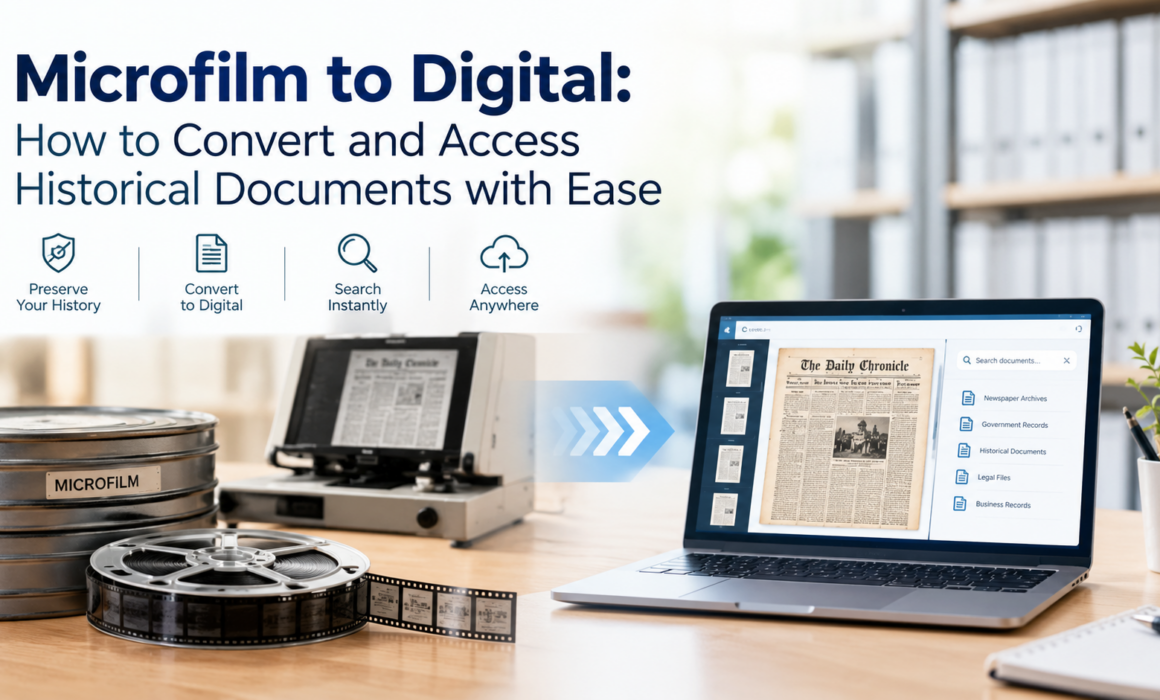
Microfilm to Digital: How to Convert and Access Historical Documents with Ease
Somewhere in most government archives, land title offices, newspaper morgues and university libraries, there is a room with rows and rows of grey cabinets and a single old reader machine. Microfilm and microfiche were the digitization technology of their era, and were a smart way to compress enormous volumes of paper into a fraction of the physical space.
The issue is that technology has continued to advance, and the equipment that was used to read them is disappearing quicker than the film itself. Organizations aren’t converting these collections to digital formats as a modernization project, but because the alternative is the possibility of losing access to the material that can’t be replaced.
The Reader Machine Is the Bottleneck
A microfilm reader is a single point of access. Reels have limitations on who can access them and where they can be accessed from. With reels and fiche cards, one person can look at one card at a time and has to be at the physical site of the fiche, assuming there is also a machine reader there. If the reader breaks, which happens increasingly often as manufacturers stop making parts for machines that are decades old, access stops entirely until it is repaired or replaced.
Digital files remove that constraint completely. Once a reel is converted, the resulting pages can be viewed by any number of people at once, from anywhere, at any hour, without anyone touching the original film again. That last part matters more than it might seem. Every pass through a reader machine is friction against a physical object that was never designed to last forever, and every conversion to digital is one less reason to spool that film through a machine again.
There is also the matter of what you can do with the image once it exists. A microfilm reader shows you a page. A digital file lets you search it, if it has been through optical character recognition, zoom into a detail without losing resolution, share it by link instead of by appointment, and back it up in more than one place at once. The comparison is less about which format looks better and more about which format can actually be used the way people need to use it today.
What the Conversion Process Involves
Microfiche scanning services and reel-to-reel microfilm scanning both work on the same basic principle, though the equipment differs. A specialized scanner passes light through the film and captures what would otherwise only be visible through a reader’s lens and screen, producing a digital image of each frame.
High-resolution microform scanning is the part that determines whether the result is actually useful. Microfilm was created specifically to hold fine detail in a small physical space, so a low-resolution capture can lose exactly the information the film was made to preserve in the first place. Text that reads clearly to the eye through a good reader lens should read just as clearly on screen, provided the scanning resolution is high enough to capture it. For most archival and genealogical material, that means scanning well beyond what a casual conversion service offers, since the whole point is retrieving the fine print, not just the general shape of the page.
Aperture card digitization is a related but distinct case worth mentioning on its own, because these cards show up constantly in engineering, land title and municipal records and get overlooked in general microfilm conversations. An aperture card is a punch card with a small window holding a single frame of microfilm, typically an engineering drawing or a land survey plan. Converting these requires equipment built specifically for the card format rather than standard reel scanners, and the drawings they hold are frequently the only surviving copy of a structure or a parcel boundary. Municipalities and utility companies working through legacy aperture card collections often find drawings referenced in active projects decades after the original was drafted.
Once frames are captured, the raw images typically go through cropping, deskewing and contrast correction, followed by optical character recognition where the source material allows it, and indexing so the resulting files can be organized and searched rather than just stored as a digital pile of pictures.
When the Film Itself Is Failing
Converting film in poor condition shifts from a preservation upgrade to an emergency. For the older acetate-based microfilm, the deterioration process is identified by the sharp vinegar smell, commonly called Vinegar Syndrome, which is a sign that the film is breaking down. If left unaddressed, the film shrinks and becomes brittle, sometimes to a point where it’s too fragile to run through any equipment at all, losing all the material in the film permanently.
Film in the early stages of this process can generally still be digitized, though it requires careful handling, controlled environmental conditions and often a slower, gentler scanning process than film in good condition. Film that has progressed further may need conservation treatment before it can be safely handled, and in advanced cases some content loss is unfortunately unavoidable. This is the core argument for treating microfilm conversion as time-sensitive rather than a project to get to eventually. Acetate deterioration does not pause while a budget decision gets made, and film that scans perfectly well today may not be scannable in five years. Digital preservation of archives is, in a very literal sense, a race against the chemistry of the film itself in cases like this.
Finding One Record Among Thousands
This is where digitization earns its keep for anyone doing historical or genealogical work. Genealogical research digitization is one of the most common reasons organizations convert historic newspaper archives, church registers, land records and vital statistics microfilm, and the reason is almost always the same. Nobody wants to scroll through a reel frame by frame looking for one small piece of information.
Properly digitized and OCR-processed documents allow collections to be searched by typing names into a search bar, with relevant results being identified quickly. Even with handwriting or aging print, searches can be narrowed using date range, record type, geographic area, or document category, which can be easier compared to physically scrolling through reels in sequence. Once digitized and properly indexed, researchers who once needed a full day at an archive can often locate a specific record within minutes of searching. Institutions that digitize genealogically significant holdings often see a large increase in research requests and public engagement simply because the material is now discoverable in ways that film never was.
Choosing a Format That Will Still Open in Thirty Years
Choosing the correct file format matters more for archival materials than for almost any other type of digital record because the main goal of conversion is longevity, and some file formats tend to become obsolete.
For long-term digital archives, the most commonly accepted standard is uncompressed or losslessly compressed TIFF files as the preservation master since TIFF is a well-documented, widely supported format that is unlikely to become unreadable as software changes. Alongside TIFF, most archives generate PDF/A versions for day-to-day access and sharing, since PDF/A is specifically designed as an archival subset of the PDF format with embedded fonts and no dependency on external resources. A common microfilm-to-PDF conversion workflow produces both an unmodified TIFF held as the permanent master and a searchable PDF/A for actual use.
What should be avoided is keeping only a compressed and proprietary file as the sole copy. Compression can permanently delete image detail, and proprietary formats run the risk of becoming unreadable once the software behind them is discontinued. The safest approach is to treat the high-resolution capture as the one file worth protecting indefinitely, and everything else as something you can always regenerate from the master when needed.
What This Means in Practice
For organizations sitting on unconverted microfilm collections, whether that is a municipal archive with aperture card drawings, a genealogical society with parish registers, or a company with decades of engineering records on reels in a basement, the decision to convert is rarely about whether it is worth doing. The material generally justifies itself simply by being irreplaceable. The real decision is timing, and for film already showing signs of deterioration, that decision has less flexibility than it might appear to.