
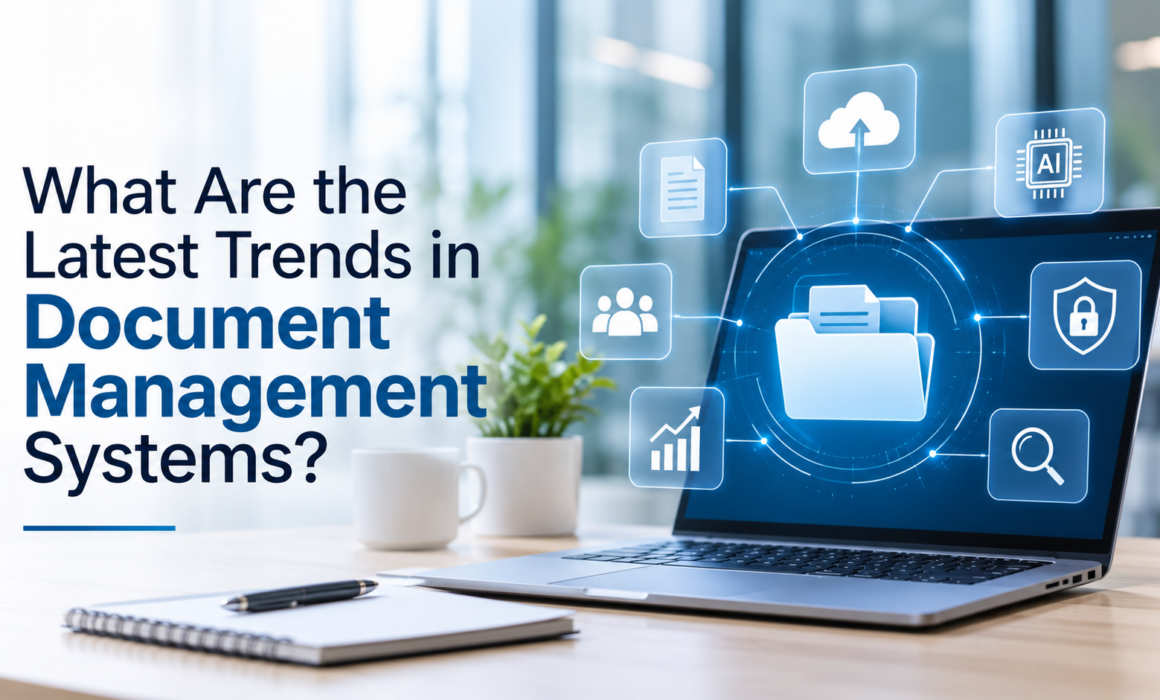
What Are the Latest Trends in Document Management Systems?
Choosing a document management system used to mean picking a secure place to put files. As times have changed, technology has evolved, and workplace practices have shifted, the bar has moved along with it. Paper used to be the main struggle organizations dealt with, but now they’re dealing with mountains of PDFs, email attachments, and duplicates scattered across drives.
The latest trends shaping document management all respond to this challenge. Here is what is changing, and what it means for anyone else whose work depends on documents.
From storage to intelligence
The biggest shift is the simplest one to explain. A document management system that only stores and retrieves files is slowly becoming outdated. Analysts and vendors across the industry have all agreed that the systems that understand what is inside the documents are what matters now.
This is the rationale behind the move from basic digitization to intelligent document processing (IDP). Instead of scanning a page and leaving it as a searchable image, IDP reads it, identifies what kind of document it is, and pulls out specific details. Industry coverage increasingly treats IDP as the default way document-heavy operations are built rather than a specialty add-on.
AI agents are entering the workflow
If IDP is about reading documents, the newest conversation is about acting on them. You will hear the phrase agentic AI a lot. In document management, it describes software that extracts data and moves it through a process.
The term is being attached to almost everything in the software world, so it is important to approach this with some skepticism because not every product delivers. The practical question for any organization is what the system will actually do on its own and what happens when it is unsure. This brings us to the next trend.
Validation and traceability are becoming the real differentiators
As automation becomes more prevalent, the questions shifts from whether it can not only read a document, but if the output is something that can be trusted. A system that can process a page quickly may still give a wrong number or name and look perfectly clean.
This is the reason more organizations want validation built into the process. Totals can be checked against line items, dates are tested for sense, and names are matched against existing records. If there are low-confidence results, rather than continuing forward, they get flagged for human review. Traceability is also becoming increasingly important, allowing people to see where each extracted value came from on the original document.
Cloud is now the default, and security is built around zero trust
Cloud-based document management has become a standard starting point instead of a debated option. The reason for this makes sense. Remote and hybrid teams need access from anywhere. Mobile access to documents has become an expectation, and keeping on-premises.
People also expect stronger security standards. Modern platforms require users and devices to be logged in and verified before they can access certain documents. Zero trust principles ensure only people who are supposed to have access to files do. Role-based controls, detailed audit trails, and encryption are starting to become basic features instead of premium add-ons.
Governance and retention automation
A related trend is the growing focus on governance and regulations. Systems can automatically apply rules for records retention schedules, legal holds, and defensible deletion. When documents reach the end of their retention period, the system can flag them for human review before deleting.
This is especially important because holding documents forever is unsafe. When personal information sits in systems, the more exposure risk it carries. Strong governance means keeping what is required, for as long as it’s needed, and disposing of the rest securely and properly.
Smarter search and better retrieval
Feedback surveys from office workers often describe the same frustration of a large amount of the working week spent hunting for information. Search is getting better at addressing it. Instead of matching exact keywords, newer systems are able to use contextual and semantic understanding.
Combined with consistent metadata captured during extraction, this turns a document repository into something people can actually question and find the information they need.
Low-code tools and open integrations
People don’t want to wait for an IT department every time a workflow needs adjusting. Low-code and no-code tools allow operations staff to build and edit approval flows, routing rules, and notifications themselves. At the same time, buyers are rejecting stand-alone systems that cannot talk to the result of their software. A document management system that connects cleanly with the rest of the required platforms, tools, and software is worth far more.
Canada’s privacy rules are changing
For organizations in Alberta and British Columbia, there is a regulatory trend worth watching closely. In June 2026, the federal government introduced Bill C-36, which proposes a new law called the Protecting Privacy and Consumer Data Act. If passed, it would replace the privacy provisions of PIPEDA, which has governed how private-sector organizations handle personal information since 2001.
As introduced, the bill would require organizations to maintain a formal privacy management program, place greater responsibility on service providers, and set new rules around data transfers outside Canada and automated decision-making. It would also move private-sector enforcement to a new commission. It is important to stress that the bill is still working its way through Parliament and could change before it becomes law, so this is a development to monitor rather than a rule to comply with today. Alberta and BC’s provincial privacy legislation also continues to apply in the meantime.
The practical takeaway for document management is that privacy compliance is trending toward being provable. Policies, procedures, retention practices, and access records may increasingly need to stand up to scrutiny. A system that already logs access, tracks where information came from, and applies retention rules consistently puts an organization in a much better position, whatever the final legislation looks like.
What this means when you choose a system
With all of these trends in play, it helps to bring the conversation back to a few practical questions. Does the system understand the content of your documents, or only store them? How does it handle values it is not sure about? Can every important data point be traced back to the original document? Where is your data stored, who can access it, and is that access logged? Can it apply your retention rules automatically? And will it connect to the tools your team already uses?
A provider who can answer those plainly is usually a better bet than one leaning on a long feature list.
Frequently asked questions
What is the biggest trend in document management right now?
The move from simple storage to intelligent processing. Systems are increasingly expected to read documents, extract key data, validate it, and feed it into workflows, rather than just filing the document away.
What is intelligent document processing?
Intelligent document processing, or IDP, combines OCR, machine learning, and language understanding to classify documents and extract specific data fields automatically. It goes well beyond turning a scan into searchable text.
Is cloud document management safe for regulated industries?
It can be, provided the platform has strong access controls, encryption, audit logging, and clear answers about where data is stored. Cloud-based systems are now the default choice even in legal, finance, and healthcare settings.
Does PIPEDA require my documents to be stored in Canada?
PIPEDA is generally accountability-based and does not itself require private-sector data to be hosted in Canada, though other rules, such as certain provincial requirements for public bodies and sector-specific guidance, can apply. It is worth confirming your specific obligations with a qualified advisor.
What is Bill C-36?
Bill C-36 is proposed federal legislation introduced in June 2026 that would replace the privacy provisions of PIPEDA with a new act. It has not yet become law and may change as it moves through Parliament.
How do I know if my document management system is outdated?
Warning signs include search that only works on exact file names, no audit trail of who accessed or changed a document, manual retention and deletion processes, and no way to trace data in your records back to the source document.